

Tea OEM/ODM Manufacturer in China
for Private Label Tea & Gift Packaging
Develop Your Tea Product and Its Packaging with Yunileaf
Yunileaf works with overseas tea brands, importers, distributors, retailers and hospitality buyers to develop private-label tea products and branded gift packaging in Quanzhou, Fujian, China. From Anxi Tieguanyin and Wuyi Da Hong Pao to custom tea tins, printed gift boxes and wooden presentation cases, we coordinate tea selection, sample review, packaging development, packing and export preparation.
Bulk loose tea starts from 30 kg. Custom packaging and private-label projects start from 500 boxes. Existing samples are generally dispatched within 7–15 days, while custom sample development takes approximately 15–30 days. The sample fee is fully refunded when the related bulk order is placed.
OEM / ODM support: tea selection · roast-profile discussion · 5 g / 10 g / 15 g portion formats · private-label tins · printed gift boxes · wooden gift cases · tea-and-teaware sets · export packing
Send Your OEM/ODM Brief | Request a Sample
One Project, From Tea Selection to Finished Retail Packaging
A tea product is not defined by the leaf alone. Buyers also need to decide how the tea will be portioned, protected, presented, labelled and shipped. Yunileaf's OEM/ODM service brings the tea specification and packaging specification into one project discussion.
A retailer may need loose tea in a practical bulk pack. A specialty tea brand may want a recognisable tin with its own logo and colour system. A corporate gifting company may need a presentation box with several tea selections and a ceramic cup. Each project has different requirements for material, appearance, packing steps, order quantity and transport protection.
We begin by confirming the target market and sales channel. We then discuss tea type, flavour direction, net weight, pack format, artwork and packaging structure. Samples are reviewed before the final specification is approved for bulk production. This allows buyers to assess the product and package before ordering printed materials or committing to a larger quantity.
The three case-study visuals on this page show different packaging directions: a blue cylindrical tea tin, a red branded tea gift box and a wooden tea presentation case. They demonstrate the types of projects buyers can discuss with Yunileaf. Final specifications depend on the selected tea, packaging structure, artwork, material availability and approved sample.
Tea Product Selection and Specification
Yunileaf's catalogue includes loose-leaf tea, oolong tea, tea bags, scented and cold-brew tea, ceramic tea sets and holiday gift sets. Buyers can start with an existing product or submit a product brief.
For loose-leaf projects, the starting point is the tea itself: origin, grade, leaf appearance, aroma, liquor character, roast profile and intended use. Anxi Tieguanyin and Wuyi Da Hong Pao are two Fujian oolong references for buyers building a Chinese tea range. Other catalogue selections can be reviewed according to the target market and product positioning.
A useful tea specification should identify the required leaf style, flavour direction, net weight and packaging format. Retail projects may also need a confirmed pack count, barcode area and label information. Tea shops, hotels and restaurants may prioritise bulk size, serving consistency and storage format.
Roast Profile Discussion for Fujian Oolong Tea
For Anxi Tieguanyin and Wuyi Da Hong Pao projects, buyers can discuss light, medium or heavier roast directions. The goal is to align the sample with the taste profile expected by target customers rather than apply one roast level to every market.
A lighter roast may be considered for a fresher impression and lifted aroma; a medium roast for a rounder cup and more developed roast character; and a heavier roast for a fuller roasted profile. These are sample-development directions, not fixed guarantees. The result depends on tea material, processing history, roast method and sample evaluation.
Before bulk production, buyers should approve a reference sample and record the agreed sensory description, including aroma, liquor colour, taste, aftertaste and visible leaf characteristics. For repeat orders, the approved sample and written specification provide a shared basis for comparison.
Private Label Packaging Options
Packaging is part of the product specification, not a last-minute decoration step. It must fit the tea, protect it during storage and transport, carry the buyer's brand information and suit the intended retail price point. Yunileaf can discuss individual tea packs and presentation gift boxes.
1. Custom Tea Tins
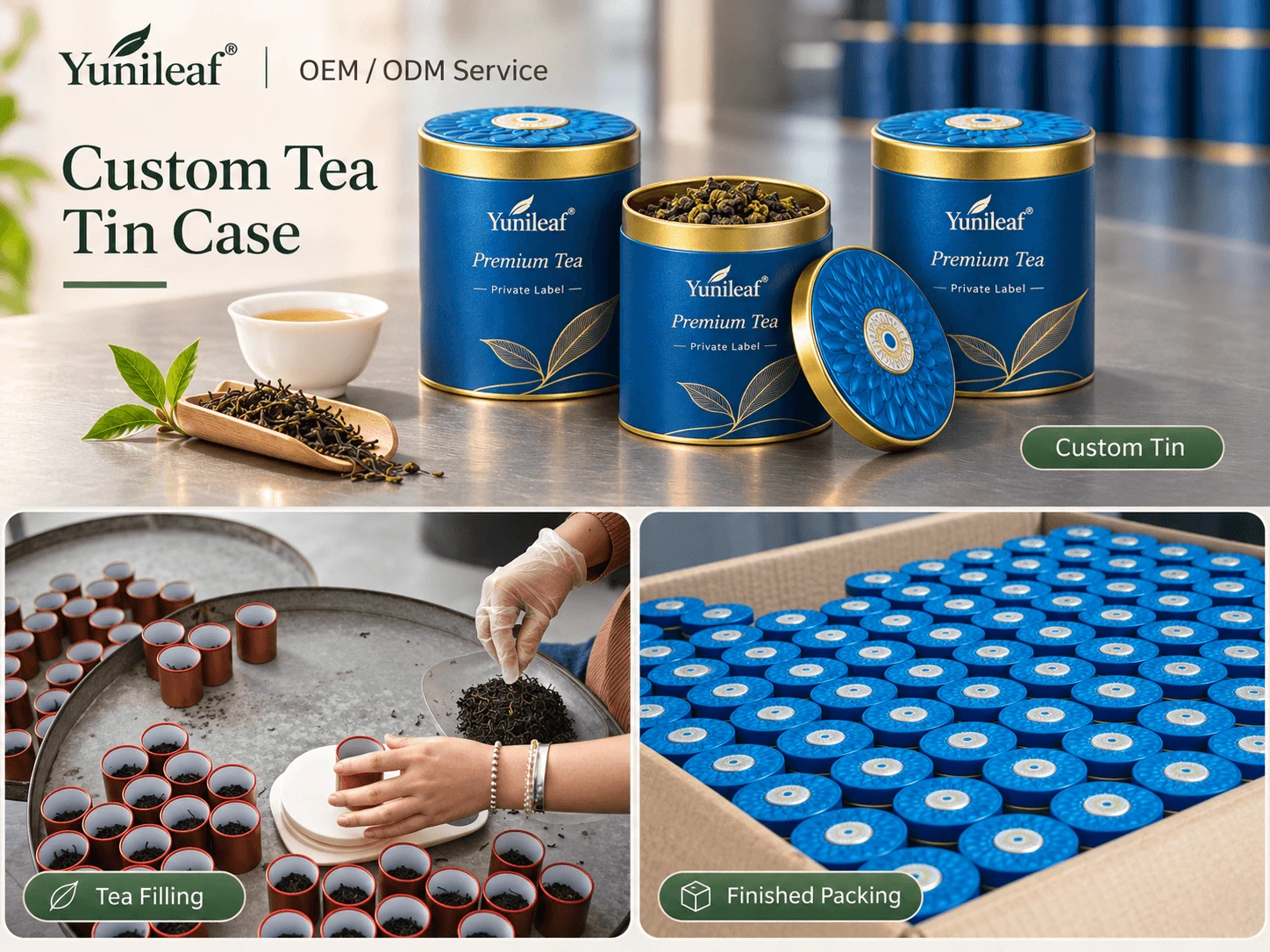
The blue tea tin case shown here features a cylindrical format, blue body, gold-coloured trim and a coordinated lid design. This direction can suit a premium loose-leaf tea line, a gift assortment or a branded tea collection.
For a custom tin project, provide the logo, preferred colour palette, product name and target net weight. The specification should confirm tin dimensions, lid structure, printing or label method, finish, inner protection requirements and outer-carton packing. A sample should be reviewed for appearance, closure fit, label placement and the fit between the tea quantity and container size.
During filling, tea should be weighed to the agreed net content, placed into the approved container and checked before the tin is closed. Finished units should be counted and packed into suitable outer cartons. The case-study visual shows tea filling and finished blue tins arranged for packing.
2. Printed Paper Gift Boxes
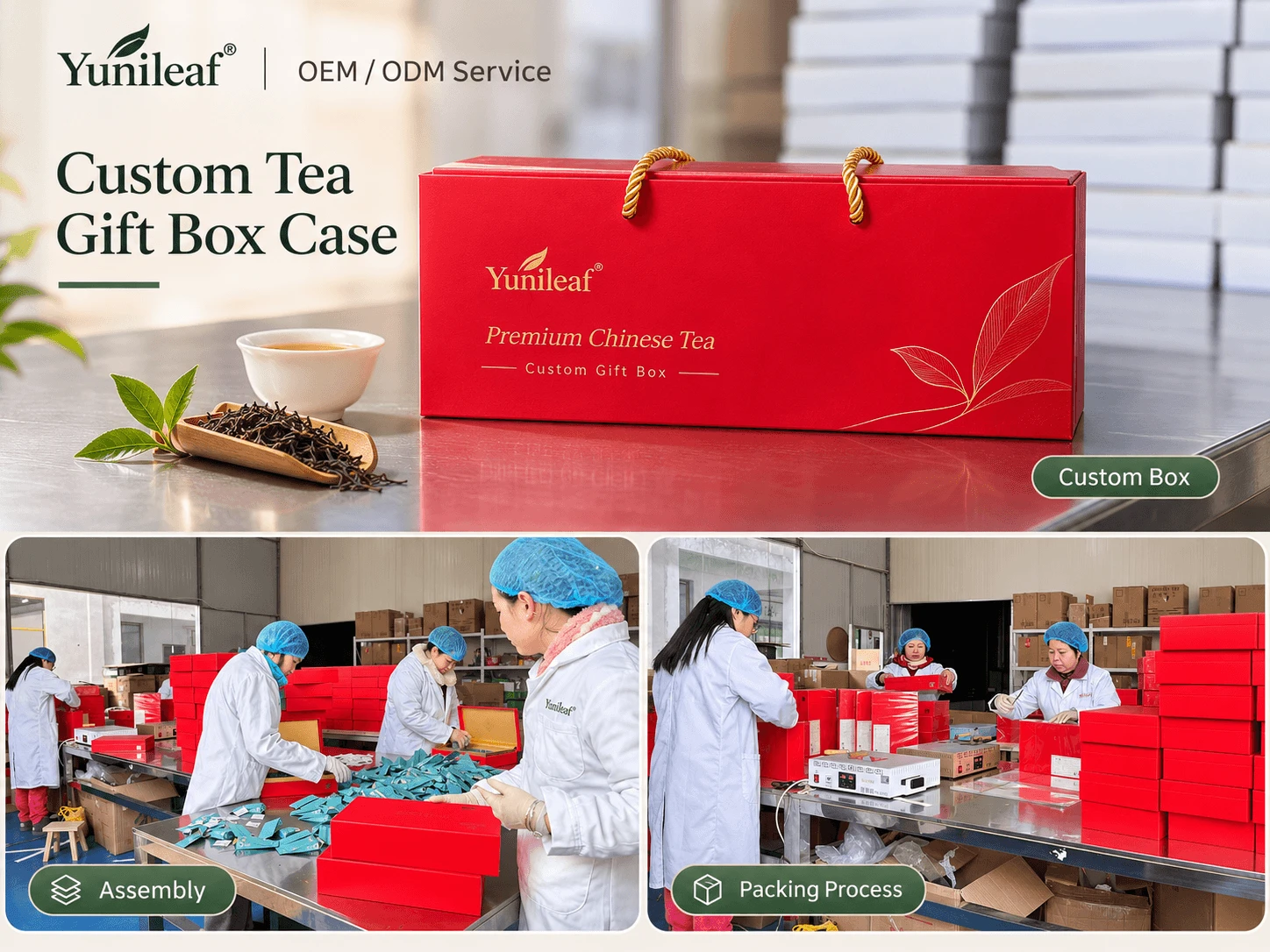
A printed paper gift box can give a tea product a clear shelf identity for seasonal promotions, corporate gifting, retail gift sections or distributor programmes. The red gift-box case shows a branded outer presentation with coordinated tea packs and a manual assembly process.
Buyers can discuss box colour, dimensions, logo placement, surface finish, opening style, handle requirements and the number of tea units inside. The internal layout should be confirmed with the outer box. Inserts or dividers may be needed to keep individual packs in position and reduce movement during handling.
Before production, review the artwork proof and a packaging sample. Checks include printed colour, text accuracy, box dimensions, opening and closing performance, insert fit and the appearance of the finished set. The packing plan should also account for the outer shipping carton.
3. Wooden Tea Gift Cases
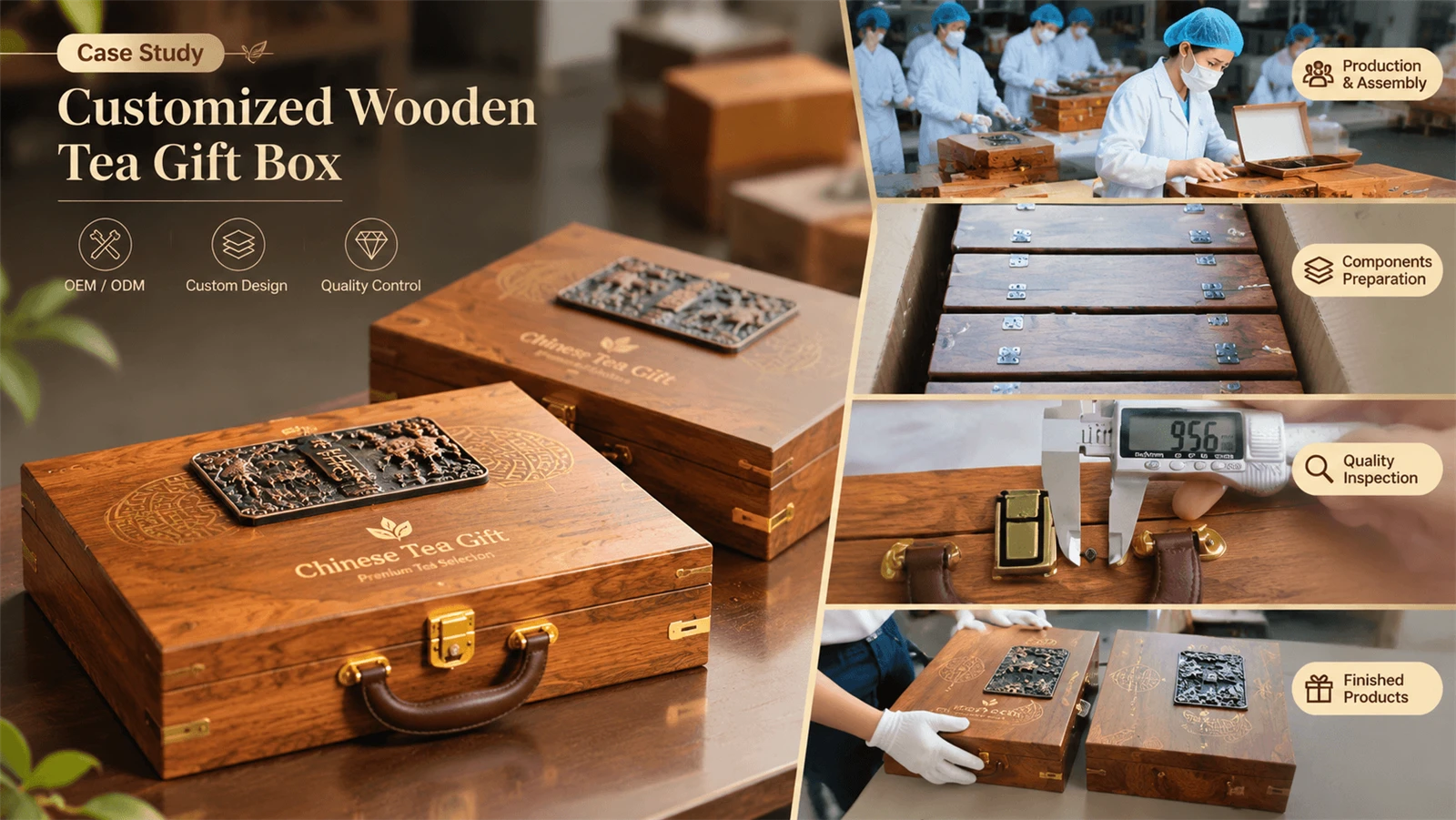
For premium gifting, a wooden tea case offers a different presentation from a standard paper box. The wooden case project shown here includes a wood-grain finish, metal fittings, a decorative top plate, a handle and a fitted presentation structure. The image sequence shows component preparation, dimensional checking, assembly and finished-product handling.
Buyers should confirm external dimensions, internal compartment layout, wood appearance, surface finish, hinge and clasp style, handle design, metal colour, logo treatment and shipping protection. If the case will hold tea tins, tea pouches or teaware, the dimensions of those items must be confirmed before the insert is finalised.
A sample review should cover lid alignment, clasp operation, handle attachment, corner finish, internal fit and visible surface quality. Buyers should also confirm whether the case is intended for repeated use, display or one-time gifting, because that affects the construction brief.
4. Tea and Teaware Gift Sets
A gift set may combine selected tea with a ceramic cup, tasting cup or brewing accessory. This format can be considered for corporate gifts, hotel welcome gifts, seasonal retail collections and brand campaigns.
The set specification should list every component, quantity, dimensions and packing position. The insert must hold the items securely without putting pressure on fragile ceramic pieces or damaging tea packaging. Buyers should review a complete assembled sample to assess appearance, opening experience, product arrangement and protection inside the gift box. A transport test can be agreed where appropriate.
Custom Portion Sizes and Tea Formats
The right pack size depends on how the product will be sold and used. A tea shop may need bulk tea for in-store service; a retail brand may require individually portioned packs; a gift box may contain several small packs for a tasting assortment.
For selected projects, buyers can discuss 5 g, 10 g or 15 g vacuum-packed tea portions. Confirm the tea type, net weight, pouch dimensions, sealing method, artwork area and number of units per retail box. A change in portion size can affect gift-box dimensions and carton configuration, so these details should be checked together.
Bulk loose tea starts from 30 kg. Custom packaging or private-label projects start from 500 boxes. The quotation should confirm whether the MOQ applies to one tea, one flavour, one tin design, one printed box design or a combined order. For projects with several varieties or packaging styles, provide the proposed SKU breakdown before requesting a quotation.
Three Custom Packaging Case Studies
Case Study 1: Blue Private Label Tea Tin
Project direction: A branded cylindrical tea tin with a coordinated blue-and-gold appearance.
The first case shows a blue tin concept with gold-coloured rim and lid detailing. Supporting panels show tea being placed into individual tins and finished units arranged in an outer carton. Key decisions include tea specification, tin size, net weight, artwork, colour reference, lid fit and carton quantity. Buyers should also confirm whether the tin is the primary retail package or will be placed inside a secondary gift box.
Image caption: Custom Tea Tin Project - branded tin design, tea filling and finished packing.
Image alt text: Custom blue private-label tea tins with gold-coloured trim, tea filling and finished tins packed for shipment.
Case Study 2: Red Branded Tea Gift Box
Project direction: A coordinated paper gift box with individually packed tea products.
The second case shows a red tea gift box as the main presentation package, supported by images of staff assembling and packing the gift units. Buyers planning a similar project should confirm the number of tea varieties, net weight of each unit, number of units per box, insert layout, artwork and outer-carton arrangement. For a seasonal launch, artwork approval and packaging material scheduling should be completed early enough to support the required delivery date.
Image caption: Custom Tea Gift Box Project - branded outer packaging, assembly and packing.
Image alt text: Red private-label tea gift box with coordinated tea packs being assembled and packed by production staff.
Case Study 3: Wooden Tea Gift Case
Project direction: A premium wooden presentation case with decorative fittings and a fitted internal layout.
The third case focuses on the construction and inspection of a wooden tea gift case. The images show the wood-grain appearance, metal fittings, component preparation, dimensional checking and final assembly. The project brief should define case dimensions, internal layout, finish, hardware, handle, logo treatment and protective shipping method. If the case contains tea tins or ceramic items, those components should be available for fit testing before the insert is approved.
Image caption: Wooden Tea Gift Case Project - component preparation, dimensional inspection and final assembly.
Image alt text: Customized wooden tea gift boxes with metal fittings, handle inspection and finished case assembly.
How Our OEM/ODM Cooperation Works
Step 1: Send the Project Brief
Share the target market, sales channel, tea category, estimated quantity, pack format and packaging direction. Include brand guidelines, logo files, reference packages or product specifications if available. Buyers who are still comparing options can send a reference image and a short description of the intended retail product. An NDA can be discussed before confidential artwork, formulas or brand documents are shared.
Step 2: Confirm Tea and Packaging Specifications
Define the product and package in writing. Tea details may include origin, grade, roast direction, taste profile, net weight and storage requirements. Packaging details may include material, dimensions, colour, printing, logo position, insert layout, unit count and outer-carton requirements. For multi-SKU projects, prepare a separate specification for each product and list undecided points as pending.
Step 3: Sample Review and Packaging Design
Existing samples are generally dispatched within 7–15 days. Custom sample development generally takes 15–30 days, depending on tea selection, packaging structure, artwork and material requirements. Shipping time after dispatch depends on destination and carrier.
Review tea and packaging samples against the written specification. For tea, record aroma, liquor appearance and taste. For tins and gift boxes, check dimensions, colour, printing, closure, insert fit and finished presentation. The sample fee is fully refunded when the related bulk order is placed.
Step 4: Approve the Final Specification
Before bulk production, confirm product name, tea specification, net weight, pack format, artwork, quantity, carton plan, delivery terms and required documents. Record approval in writing. Any later change may affect cost, material availability or schedule.
Step 5: Production, Filling and Packing
After order details and materials are confirmed, work may include tea preparation, weighing, filling, sealing, tin packing, gift-box assembly, insert placement, set counting and outer-carton packing. For a multi-component gift set, agree on the packing sequence before work begins and use a checklist for SKU, component count and package arrangement.
Step 6: Final Checks and Export Preparation
Before dispatch, check the finished order against the approved specification. Checks can include product identity, net weight or unit count, packaging appearance, closure, carton quantity, shipping marks and visible damage. Confirm the export document list according to destination market, product type and shipping arrangement.
MOQ, Sample Timing and Order Planning
The following starting terms are provided for initial planning. The final quotation should state the confirmed MOQ, unit price, sample cost, production schedule and shipping terms for the selected product and packaging structure.
| Project Type | Starting MOQ | Sample Timing | Notes |
|---|---|---|---|
| Bulk loose tea | 30 kg | Existing samples: 7–15 days to dispatch | Tea type and grade to be confirmed |
| Custom packaging / private label | 500 boxes | Custom samples: 15–30 days | Special structures may require separate confirmation |
| Custom tea tin | Confirm in quotation | 15–30 days for custom sample | Tin dimensions, artwork and quantity affect specification |
| Paper tea gift box | 500 boxes | 15–30 days for custom sample | Box structure, inserts and print finish require approval |
| Wooden tea gift case | Confirm in quotation | 15–30 days for custom sample | Hardware, dimensions and construction may affect MOQ |
| Tea and teaware gift set | Confirm by set composition | 15–30 days for custom sample | Tea, teaware, inserts and outer box must be checked together |
The 7–15-day period refers to dispatch preparation for existing samples, not guaranteed arrival. The 15–30-day period refers to custom sample development. International transit time, customs clearance and additional testing are separate considerations. For bulk orders, production lead time should be confirmed after sample, artwork, packaging materials and order quantity are approved.
Quality Checks for Tea and Custom Packaging
Quality control should follow the approved specification. For tea, the buyer and supplier should agree on product identity, grade, appearance, aroma, taste, net weight and packaging requirements. If laboratory testing or a specific market standard is required, confirm the test items, laboratory, sampling plan and report format before the order is placed.
For packaged tea, the packing checklist can include the correct tea SKU, filling quantity, pouch seal, tin closure, label position, date and lot information where applicable, unit count and carton marks. For gift boxes, checks should also cover insert layout, product arrangement, box opening and closing, visible print defects and whether components remain in place during normal handling.
For wooden cases, inspection points may include overall dimensions, lid alignment, hinge and clasp function, handle attachment, surface finish, decorative plate position and internal fit. A reference sample and written specification provide a shared basis for checking repeat orders. Any agreed tolerance or special inspection requirement should be written into the purchase specification.
Export Labels, Documents and Market Requirements
Food labelling and import requirements differ by destination, product category and sales channel. Before artwork is finalised, identify the destination country and provide the label rules that apply to the product. Typical label fields may include product name, ingredient list, net weight, country of origin, storage instructions, brewing directions, lot identification and best-before information. Allergen statements and other mandatory warnings must be assessed according to actual ingredients and local rules.
Yunileaf can coordinate the product and packaging information needed for the agreed label layout. The buyer should check final artwork for local regulatory compliance before printing. Claims such as organic, health-related, allergen-free or specific residue-compliance statements should only be printed when the product has the required evidence and the wording is permitted in the destination market.
Export documents depend on the product, destination and shipping terms. Confirm the required document list at quotation or order-confirmation stage. Where applicable and available, the parties can discuss commercial invoices, packing lists, certificates of origin, product specifications, test reports or other documents requested by the importer. No certificate or test result should be assumed to apply to every product or batch.
Confidentiality and Brand Ownership
Private-label projects often involve unreleased brand names, packaging artwork, product concepts, pricing and supplier information. Buyers can request an NDA discussion before sending confidential files. The agreement should define the information covered, permitted use of artwork and ownership of buyer-supplied materials.
Submit final logo files, brand colours, fonts and mandatory label text in an agreed format. Retain the approved artwork proof as the production reference. If a design changes after approval, the revised file should be versioned and re-approved before printing. Any tooling, mould, plate or setup costs should be listed separately in the quotation where applicable.
Who Uses Yunileaf OEM/ODM Services?
Tea brands and private-label owners may need a stable tea specification, branded tins, retail pouches or gift packaging that matches an existing brand identity.
Importers and regional distributors may prefer bulk loose tea or finished private-label units that fit their local distribution model. Their brief should identify the target market, preferred pack size, expected order volume and required import documents.
Retail chains and specialty stores may need consistent retail units, clear product information, barcode placement and gift-ready packaging. Multi-SKU projects should include a product-by-product packing list.
Hotels, restaurants, tea rooms and hospitality buyers may need bulk tea for service, individually packed portions for guest rooms or branded gift sets for seasonal programmes.
Corporate gifting and promotional buyers may need a custom paper box or wooden presentation case, with tea and optional teaware arranged as a complete gift. Their brief should include the event date, quantity, recipient profile and branding deadline.
Explore Yunileaf Tea and Gift Categories
Review related product ranges before preparing your project brief:
Chinese Oolong Tea - Fujian oolong selections, including Anxi Tieguanyin and Wuyi Da Hong Pao.
Tea Bags - scented tea, fruit infusions and cold-brew tea formats.
Ceramic Tea Sets - cups, tasting cups and tea-brewing accessories for gift-set planning.
Holiday Gift Sets - tea gift formats for retail and seasonal programmes.
Corporate Tea Gift Boxes - presentation sets for business gifting and brand projects.
Frequently Asked Questions
What is the MOQ for bulk tea?
The starting MOQ for bulk loose tea is 30 kg. The final quotation confirms tea type, grade, packaging method and quantity.
What is the MOQ for private-label packaging?
The stated starting MOQ for custom packaging and private-label orders is 500 boxes. Special tin or wooden-case structures may need separate confirmation.
How long does sampling take?
Existing samples are generally dispatched within 7–15 days. Custom sample development generally takes 15–30 days. Delivery time after dispatch depends on destination and carrier.
Is the sample fee refundable?
Yes. The sample fee is fully refunded when the related bulk order is placed. The arrangement should be recorded in the quotation or order confirmation.
Can I customise a tea tin or gift box with my logo?
Yes. Submit your logo and packaging references for review. Final options depend on the selected structure, artwork, material availability and approved sample.
Can I develop a wooden tea gift box?
Yes, as a custom packaging project. Provide target dimensions, internal layout, finish, hardware preferences, logo treatment and estimated quantity.
Can tea and teaware be packed in one gift set?
Tea and selected teaware can be discussed as a combined gift-set project. Review the tea, teaware, insert and outer box together to confirm fit and protection.
Can Yunileaf sign an NDA?
Buyers can request an NDA discussion before sharing confidential product concepts, artwork or brand information.
Can you guarantee compliance with every destination market?
Requirements vary by country and product. Identify the destination market and provide the applicable rules. Product claims, label text, test reports and certificates must be confirmed for the specific product and shipment.
Request a Tea OEM/ODM Quotation
Send Yunileaf your product category, tea type, packaging preference, estimated quantity and destination country. Attach a reference photo, existing package, brand guideline or target retail specification if available. We can review the brief and advise whether bulk loose tea, private-label tea tins, printed gift boxes, wooden tea gift cases or a combined tea-and-teaware set is the right project route.
To help us prepare a useful quotation, include:
Product: tea type, origin preference, roast direction or blend reference.
Format: bulk loose tea, 5 g / 10 g / 15 g portions, tea tin or gift set.
Packaging: tin, paper box, wooden case, insert or teaware combination.
Quantity: estimated order quantity and number of SKUs.
Market: destination country and intended sales channel.
Timing: sample target date and required shipment date.
Branding: logo, artwork, colour references and label requirements.
Contact Yunileaf
Email: lynn@yunileaf.com
Email: Sushan@yunileaf.com
Phone: +86 130 5561 8758
Quote request: https://www.yunileaf.com/inquiry
Start with a sample. Approve the tea and packaging. Confirm the specification. Then move to your private-label order.