

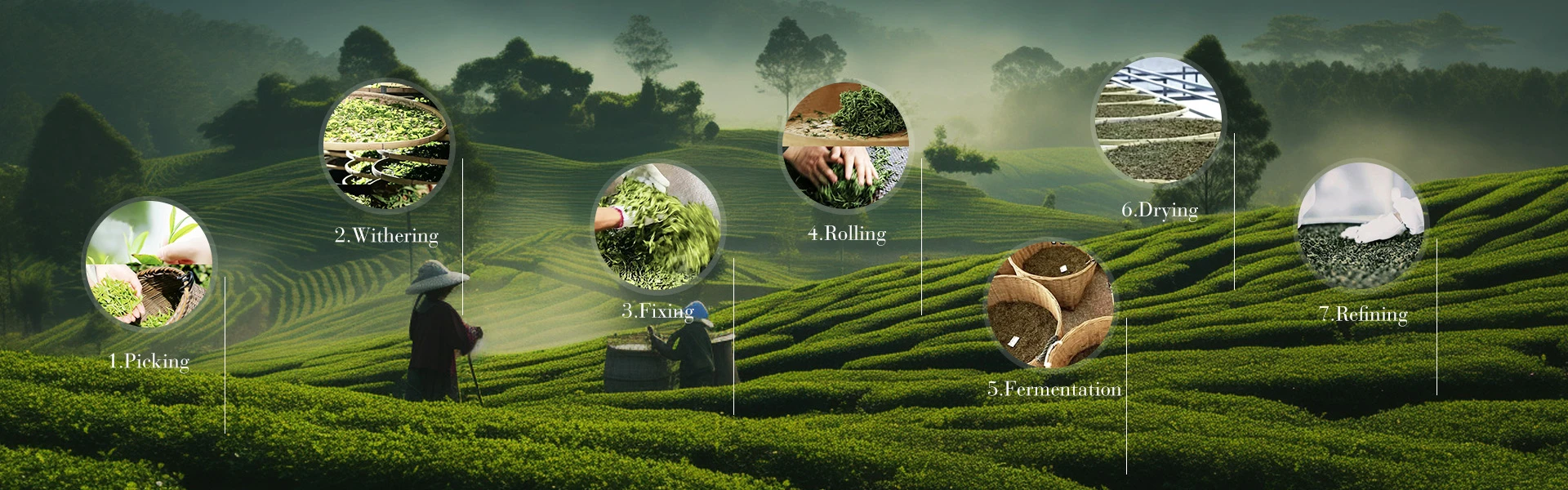
Chinese teas are categorized by production method into several major types-such as green, black, oolong (qing), dark (hei), white, and yellow teas-with each category encompassing numerous specific varieties.
Green Tea
Green tea is classified as a "non-fermented" tea. Its quality is characterized by fresh green leaves and an appealing appearance, aroma, and mellow flavor.
Classifications include: Pan-fired green tea (e.g., long-leaf *Chaoqing* like *Meicha*; round *Chaoqing* like *Gunpowder*/*Zhucha*; and flat *Chaoqing* like West Lake *Longjing*);
Baked green tea (e.g., standard baked teas like *Minnan Qing* and Zhejiang baked teas; and tender, high-grade baked teas like Huangshan *Maofeng* and Taiping *Houkui*);
Steamed green tea (e.g., *Sencha* and Enshi *Yulu*);
Sun-dried green tea (e.g., *Dianqing*, *Chuanqing*, and *Shaanqing*).
Famous varieties include West Lake *Longjing* (Hangzhou), *Biluochun* (Jiangsu), "Green Gem" (*Lvbaoshi*) tea (Guizhou), Xinyang *Maojian* (Henan), Huangshan *Maofeng* (Anhui), and Lu'an *Guapian* (Anhui).
Black Tea
Black tea undergoes "full fermentation," resulting in a characteristic red liquor and reddish leaves, with a sweet aroma and mellow taste. Major global production regions include China, Sri Lanka, India, and Kenya.
Unlike green tea, which loses flavor as it ages, black tea can be stored for a considerable time; this durability makes it suitable for long-distance transport and export.
Historically, when black tea was first created, it was known as "dark tea" (*Wu Cha*), which is why it is called "Black Tea" rather than "Red Tea" in English.
Classifications include: *Souchong* black tea (e.g., *Zhengshan Souchong* and *Waishan Souchong*);
*Gongfu* (Congou) black tea (e.g., *Dianhong Gongfu*, Ruby tea, *Chuanhong Gongfu*, *Qihong Gongfu*, and *Dancong* black tea);
Broken black tea (e.g., leaf, fannings, dust, and broken grades).
Famous Chinese black teas include *Zhengshan Souchong* and *Jin Jun Mei* (Wuyi Mountains), *Qihong* (Anhui), *Dianhong* (Yunnan), and premium *Dancong* black tea.
Qing Tea (Oolong Tea)
Qing tea, also known as Oolong tea, is classified as a "semi-fermented tea." It sits between green tea and black tea, possessing characteristics of both. Visually, the leaves are robust and tightly twisted, displaying a glossy, greenish-grey hue. The liquor is golden-yellow with a rich, fragrant aroma-often featuring distinct floral notes-while the brewed leaves exhibit a characteristic "green leaf with red edges" appearance.
Oolong tea classifications include: Guangdong Oolong (e.g., Phoenix Dancong, Lingtou Dancong);
Southern Fujian Oolong (e.g., Tieguanyin, Huangjingui, Benshan, Maoxie, Tanping Shuixian, Baiya Qilan);
Northern Fujian Oolong (e.g., Wuyi Dahongpao, Wuyi Rougui, Wuyi Shuixian);
Taiwan Oolong (e.g., Dongding Oolong, Alishan Oolong, Baihao Oolong/Oriental Beauty, Wenshan Baozhong).
Among these, Phoenix Dancong stands out within the Oolong family as a high-quality tea known for its particularly rich, full-bodied flavor and intense fragrance.
Hei Cha (Dark Tea)
Hei Cha is classified as a "post-fermented tea" and is a category unique to China. It is primarily produced in regions such as Yunnan, Hunan, Hubei, Sichuan, and Guangxi; notably, Yunnan's Pu'er tea has enjoyed a long-standing, prestigious reputation both domestically and internationally. The tea leaves are dark brown to black, coarse, and mature, with a robust aroma; they are frequently used as raw material for compressed tea products. As a post-fermented tea, its flavor becomes increasingly mellow and rich with age. The liquor ranges from orange-yellow to dark brown and often carries a distinctive pine-smoke aroma.
Hei Cha classifications include: Hunan Hei Cha (e.g., Anhua Black Brick, Fu Brick, "Gan Liang" Tea);
Hubei Laoqing Tea (e.g., Zhaoliqiao Green Brick Tea, Chongyang Laoqing Tea);
Sichuan Bian Cha/Border Tea (e.g., Nanlu Bian Cha, Xilu Bian Cha);
Yunnan Hei Cha (collectively known as Pu'er tea, though Pu'er is now often categorized as a distinct tea family);
Guangxi Hei Cha (e.g., Guangxi Liubao Tea).
White Tea
White tea is a "lightly fermented tea" characterized by leaves covered in fine white down. It is a rare and prized specialty among Chinese teas, primarily produced in Fujian locations such as Fuding, Zhenghe, Songxi, and Jianyang. There is a saying regarding white tea: "One year it is tea, three years it is medicine, and seven years it is a treasure." White tea is categorized into bud tea and leaf tea based on the tea plant variety and the harvesting standard of the raw material (fresh leaves): tea made from single buds is called "Silver Needle" (Baihao Yinzhen); tea made from leaves is called "Longevity Eyebrow" (Shoumei); and tea made from a mix of buds and leaves is called "White Peony" (Bai Mudan). It is characterized by silvery-white downy hairs, plump buds, a bright yellow liquor, a fresh and mellow taste, and tender, uniform infused leaves.
Classification of white tea: Bud tea-Silver Needle (Baihao Yinzhen); Leaf tea-White Peony (Bai Mudan), Longevity Eyebrow (Shoumei), etc.