

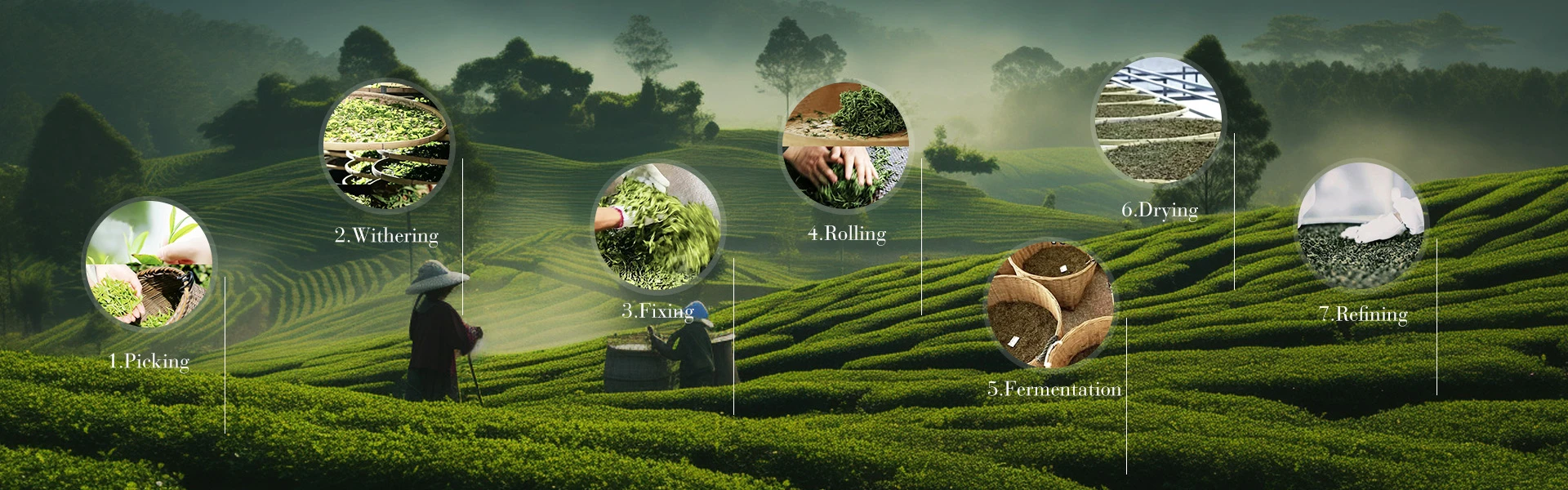
The processing of green tea generally consists of three steps: fixation (killing the green), rolling, and drying; among these, fixation is the critical stage. During fixation, high heat deactivates enzymes in the fresh leaves. Consequently, the various chemical constituents within the leaves undergo physicochemical changes driven by heat rather than enzymatic activity, thereby shaping the characteristic qualities of green tea.
Fixation
Fixation plays a decisive role in the quality of green tea. High temperatures destroy the activity of enzymes in the fresh leaves, halting the oxidation of polyphenols and preventing the leaves from turning red. Simultaneously, the process evaporates some of the leaf's moisture, softening the tissue and preparing it for the subsequent rolling and shaping stages. As moisture evaporates, low-boiling-point aromatic compounds responsible for the "grassy" odor dissipate, thereby enhancing the tea's overall aroma.
With the exception of certain specialty teas, this process is typically carried out using a fixation machine. Factors influencing the quality of fixation include temperature, leaf loading volume, the type of machine used, duration, and the specific fixation method employed; these factors are interconnected and mutually dependent.
Pan-Fired Green Tea (Chaoqing)
Depending on the mechanical or manual forces applied during processing, the finished tea takes on various shapes-such as long strips, pellets, flat blades, needles, or spirals-leading to classifications like long pan-fired tea, round pan-fired tea, and flat pan-fired tea.
Long pan-fired tea is known as "Chunmee" (Eyebrow Tea) after refining. Varieties include *Zhenmei* (Precious Eyebrow), *Gongxi*, *Yucha* (Rain Tea), *Zhenmei* (Needle Eyebrow), and *Xiumei* (Elegant Eyebrow), each possessing distinct quality characteristics. For instance, *Zhenmei* features tightly rolled, straight, and slender strips (resembling the elegant eyebrows of a lady), a lustrous green color with a "frosty" bloom, a fresh and high-pitched aroma, a rich and brisk taste, and a bright, greenish-yellow liquor and leaf base. *Gongxi* is a round-shaped variety of pan-fired tea; it is designated as *Gongxi* after the refining process. Its appearance consists of granules resembling Gunpowder tea-round, tightly rolled, and uniform-free of tea dust; it features a uniform green color, a pure aroma, a fairly robust taste, a yellow-green liquor, and a relatively tender, uniform infused leaf base. "Rain tea" (Yu Cha): Originally separated from Gunpowder tea as elongated leaves, most Rain tea is now derived from *Mei Cha* (Chun Mee); it features fine, short, and reasonably tight strips, a uniform green color, a pure aroma, a fairly robust taste, a yellow-green liquor, and a relatively tender, uniform infused leaf base. Round Pan-fired Green Tea (*Yuan Chaoqing*): Characterized by round, tight granules; depending on the production area and processing method, it is further categorized into varieties such as *Ping Chaoqing* (Pingshui Green), *Quangang Huibai*, and *Yongxi Huoqing*.
*Ping Chaoqing*: Produced in counties such as Shengxian, Xinchang, and Shangyu in Zhejiang Province. Historically, the rough tea (*maocha*) was consolidated in Pingshui Town, Shaoxing, for refining and distribution; the finished tea-resembling pearls in its fine, round, and tight form-is known as "Pingshui Gunpowder" or "Pinglü," while the rough tea is called *Ping Chaoqing*. Flat Pan-fired Green Tea (*Bian Chaoqing*): Categorized primarily into three types-Longjing, Qiqiang, and Dafang-based on production area and processing method.
Basket-fired Green Tea (*Hongqing*)
This tea is dried using a bamboo firing basket. After refining, most *Hongqing* rough tea serves as the base for scented teas; its aroma is generally less intense than that of pan-fired green tea, though a few renowned *Hongqing* varieties are of exceptional quality. Based on appearance, it can be classified into strip-shaped, spear-shaped, flake-shaped, and needle-shaped teas. Strip-shaped *Hongqing* is produced in major tea-growing regions across the country, while spear-shaped and flake-shaped teas are primarily produced in provinces such as Anhui and Zhejiang. Notable specialty *Hongqing* varieties include Mabian Yunwu Tea, Huangshan Maofeng, Taiping Houkui, Tingxi Lanxiang, Lu'an Guapian, Jingting Lüxue, Tianshan Green Tea, Guzhu Zisun, Jiangshan Lümudan, Emei Maofeng, Jinshui Cuifeng, Xiazhou Bifeng, and Nannuo Baihao. For example, Huangshan Maofeng is produced in the Huangshan area of Shexian County, Anhui Province. The leaves are tender and slightly curled, with plump, uniform, and pointed buds resembling "sparrow tongues." They possess a lustrous golden-yellow hue-often described as "ivory-colored"-and an aroma that is fresh, clear, and lingering. The liquor is a clear, bright apricot-yellow, offering a mellow, fresh, and brisk taste with a sweet aftertaste. The infused leaves remain intact as clusters, appearing thick and vibrant.
Sun-dried Green Tea (*Shaiqing*)
This type is dried using sunlight. Production is concentrated in Hunan, Hubei, Guangdong, Guangxi, and Sichuan, with smaller quantities produced in Yunnan and Guizhou. Among sun-dried green teas, the Yunnan large-leaf variety-known as "Dianqing"-is considered the finest. Other varieties (such as *Chuanqing*, *Qianqing*, *Guiqing*, and *Eqing*) have their own merits but generally do not match the quality of *Dianqing*.
Steamed Green Tea (*Zhengqing*)
Steaming to deactivate enzymes (*shaqing*) was the traditional method used in ancient my country. It was introduced to Japan during the Tang Dynasty and remains in use there today, whereas my country shifted to pan-firing during the Ming Dynasty. Steaming utilizes steam to inhibit enzyme activity in fresh leaves, resulting in the characteristic "three greens": dark green dry leaves, pale green liquor, and bright green infused leaves. However, the aroma tends to be somewhat muted with a raw, grassy note, and the taste is more astringent-lacking the brisk freshness of pan-fired green tea. Driven by foreign trade demands, my country has produced small quantities of steamed green tea since the mid-1980s. Key varieties include *Enshi Yulu* (produced in Enshi, Hubei) and "Chinese Sencha" (produced in Zhejiang, Fujian, and Anhui).
Green tea is the oldest category of tea. The ancient practice of gathering and sun-drying wild tea buds and leaves for storage can be viewed as the inception of green tea processing in a broad sense-a tradition dating back at least three thousand years. However, green tea processing in the true sense began with the invention of the steaming method in the 8th century AD. By the 12th century, the pan-firing method was invented; these techniques matured significantly and have been continuously refined and used to the present day.
Rolling (*Rounian*)
Rolling is the step in green tea production that shapes the leaves. External force is applied to break the leaf tissue, causing the leaves to curl into strips and reduce in volume, which facilitates brewing. Simultaneously, some tea juices are squeezed onto the leaf surface, playing a crucial role in enhancing the concentration and richness of the tea's flavor. The rolling process in green tea production is categorized into "cold rolling" and "hot rolling." Cold rolling involves rolling the leaves after they have been spread out to cool following the fixation (kill-green) step, whereas hot rolling involves rolling the leaves while they are still hot, without the intermediate cooling phase. Cold rolling is preferred for tender leaves to preserve a bright yellow-green liquor and a tender green leaf base, while hot rolling is suitable for mature leaves to facilitate the formation of tight, well-defined strips and minimize the production of tea dust or fragments.
Drying
The purpose of drying is to evaporate moisture, shape the leaves, and fully develop the tea's aroma. Drying methods include baking, pan-firing, and sun-drying. The drying process for green tea typically involves an initial baking stage followed by pan-firing. Since the leaves retain high moisture content after rolling, proceeding directly to pan-firing would cause them to quickly clump together inside the machine and result in tea juices sticking to the pan walls. Therefore, the leaves are first baked to reduce their moisture content to a level suitable for pan-firing.